Context-aware Decision-making Framework for Trustworthy Service Evaluation in Social Internet of Things (SIoT)
Project
Table of Contents
- Overview
- Introduction
- Problem Definition
- Mathematical Model and Context
- Modules and Architectures
- Evaluation Metrics
- Simulation Settings and Performance Comparison in SIoT Environments
- Results
- Conclusion
- Resources
- Project repository
Overview
This project presents a comprehensive, context-aware decision-making framework for trustworthy service evaluation in Social Internet of Things (SIoT) environments. It introduces a mathematical model and the Mutual Context-aware Trustworthy Service Evaluation (MCTSE) framework, which computes trust scores by integrating multiple contextual factors—including device status, environment (time and location), task type, service quality similarity, and social relationships. By combining these metrics with contextual feedback from past interactions, the framework enables devices to select the most trustworthy service providers while mitigating malicious behaviors and reputation attacks. Simulation results demonstrate the effectiveness and resilience of the proposed approach.
Introduction
The Social Internet of Things (SIoT) extends the traditional Internet of Things (IoT) by allowing devices to form social relationships based on their owners’ relationships in Online Social Networks (OSNs). These socially connected devices can then discover, request, and provide services collaboratively in smart environments such as smart homes, smart cities, traffic systems, and healthcare applications.
A fundamental challenge in SIoT environments is trustworthy service evaluation. Devices may behave honestly or dishonestly, and dishonest devices can exploit social relations to promote low-quality or malicious services. Existing trust management approaches in SIoT typically rely on:
- QoS-based trust (e.g., service quality, availability), and
- Social-relation-based trust (e.g., friendship, co-location).
However, these approaches largely ignore contextual factors such as device status, environment, and task type. As a result, they fail to distinguish trustworthy and untrustworthy devices in real-world, dynamic scenarios.
This work introduces a context-aware decision-making framework for trust evaluation that explicitly incorporates multiple trust contexts to improve service selection reliability in SIoT systems.
Problem Definition
The problem which is addressed in thi sprojec is :
How can service-consuming and service-providing devices in SIoT environments reliably evaluate each other’s trustworthiness when trust depends on multiple contexts?
In the SIoT model:
- Devices belong to users connected through a social network.
- Devices act as service consumers (SC) or service providers (SP).
- Trustworthiness depends not only on past interactions and social relations, but also on:
- device status (e.g., energy, capability),
- environment (time and location), and
- task type.
Existing trust models treat trust as either:
- non-contextual, or
- single-context (e.g., only service quality or task type).
Such models fail to:
- detect dishonest behavior consistently,
- resist reputation attacks (e.g., bad-mouthing, self-promotion),
- adapt to changing conditions.
The goal is to compute mutual, context-aware trust values that allow devices to select the most trustworthy partners for service transactions.
Mathematical Model and Context
In our SIoT model, there are $M$ devices which are denoted by $D = {d_1, \ldots, d_M}$ and there are $N$ users which are denoted by $U = {u_1, \ldots, u_N}$. Let the social network between users be represented by an undirected graph $G = {U, E}$, where $E \subseteq U \times U$, and $\langle u, v \rangle \in E$ means there is a social relation between $u$ and $v$.
Moreover, there are $I$ service-consuming devices and $J$ service-providing devices by considering the social relations of their owner, which are represented by $SC = {SC_1, \ldots, SC_I}$ and $SP = {SP_1, \ldots, SP_J}$, respectively.
In addition, each of $SC_i$ or $SP_j$ is represented by a vector in a three-dimensional space of the contexts in SIoT including status ($CS$), environment ($CE$), and task type ($CT$), which are represented by $C = {CS, CE, CT}$. Each of $CS$, $CE$, $CT$ has different values represented by:
\[CS = \{CS_1, \ldots, CS_h\}, \\ CE = \{CE_1, \ldots, CE_{h'}\}, \\ CT = \{CT_1, \ldots, CT_{h''}\}\]The vectors of $\vec{SC}_i$ and $\vec{SP}_j$ are represented by Eq. (1) and Eq. (2), respectively. Each of $SC_i$ and $SP_j$ has a list of the owner’s friends and a list of the owner’s community of interests.
Also, let $S = {s_1, \ldots, s_l}$ denote the set of services which are provided or consumed by devices in different time $\tau = {t_1, \ldots, t_p}$ and locations $L = {l_1, \ldots, l_q}$.
Moreover, each of $SC_i$ and $SP_j$ has a user satisfaction level or ground truth. The aim of this project is to provide a list of trustworthy service-providing devices and service-consuming devices for each transaction.
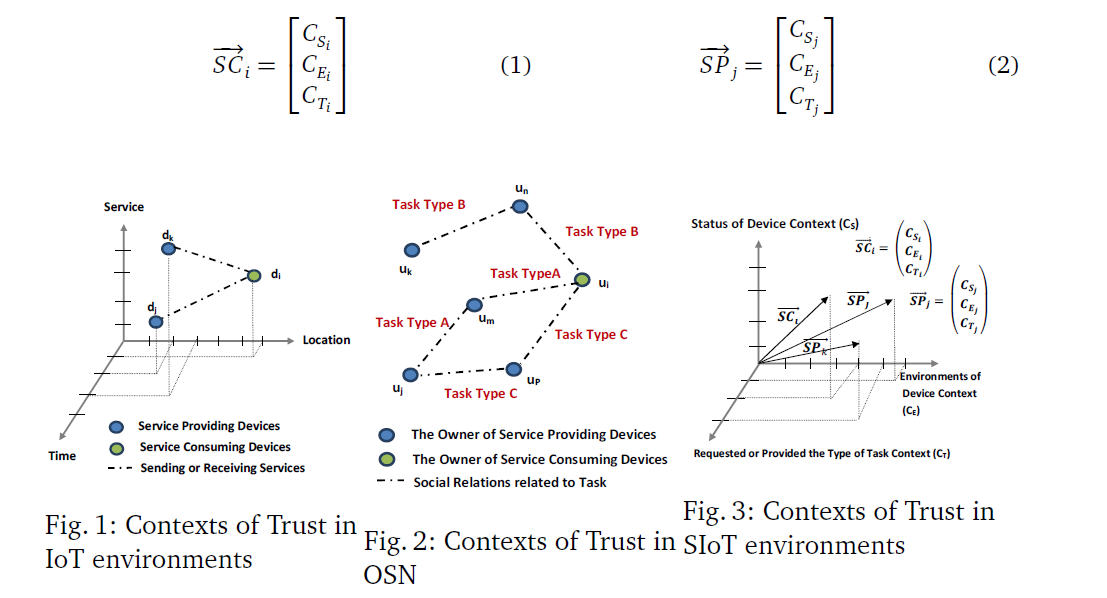
Figures 1,2,3 depict the contexts of trust in Social Internet of Things (SIoT) environments which are categorized into three main dimensions: device status, environment (time and location), and task type, with each device represented as a vector within this three-dimensional context space.
Modules and Architectures
Metrics of Contextual Trust Evaluation
To enable accurate trust assessment in Social Internet of Things (SIoT) environments, this work defines a set of contextual trust metrics that capture both individual device capabilities and social relationships under varying contexts. The proposed metrics are categorized into independent metrics and dependent metrics. Independent metrics focus on context-aware Quality of Service (QoS) by modeling the similarity between the expected QoS of a service-consuming device and the advertised QoS of a service-providing device under specific device status and environment contexts. Dependent metrics capture contextual social trust, incorporating social similarity based on friendship, community of interest, and device social relations (e.g., ownership, co-work, co-location), all evaluated with respect to a given task type context. In addition, the model integrates contextual feedback of trust from past interactions and applies variance-based weighting to penalize inconsistent or malicious behavior. Together, these metrics provide a multi-dimensional, context-aware foundation for robust trust evaluation, enabling effective differentiation between honest and dishonest devices and improving resilience against trust-related attacks.
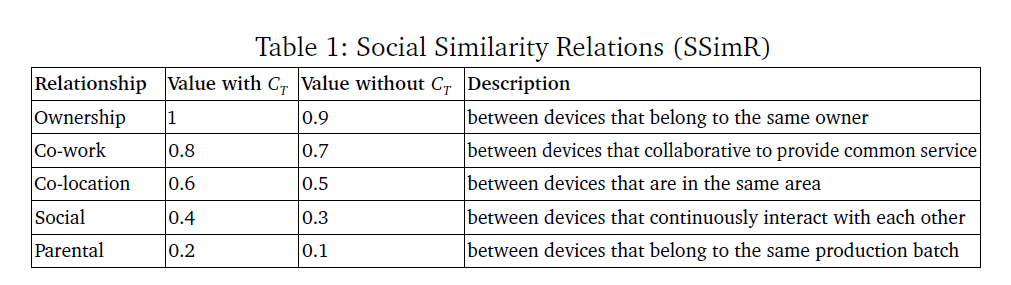
We consider different weighted values for each device social relations with other devices which are listed in Table 1. For example, if two devices have the same owner while they provide or request the same type of tasks, the weighted value is equal to 1. If they have the same owner but they provide or request different types of tasks, the weighted value is equal to 0.9. Moreover, if there are different social relations between two devices, only the highest weight is considered.
Mutual Context-aware Trustworthy Service Evaluation (MCTSE)
The proposed model integrates two major trust components:
- Context-aware QoS Similarity Trust (CQoSSTrust)
| Aspect | Description |
|---|---|
| What is measured | Similarity between expected QoS of a service consumer and advertised QoS of a service provider |
| Computation method | Cosine similarity |
| Purpose | Reflects how well a provider matches a consumer’s needs under specific status and environment contexts |
- Context-aware Social Similarity Trust (CSSTrust)
| Aspect | Description |
|---|---|
| What is measured | Social similarity under a given task type |
| Components combined | Social friendship similarity, community-of-interest similarity, device social relations (ownership, co-work, co-location, etc.) |
| Weighting | Weighted combination allows flexible importance assignment |
- Contextual Feedback with Variance
| Aspect | Description |
|---|---|
| Uses past interaction feedback | Incorporates historical feedback from previous interactions to inform trust evaluation. |
| Variance-based weighting | Applies weighting to penalize inconsistent or malicious behavior, reducing the impact of unreliable feedback. |
| Attack detection | Enables detection of on-off and self-promoting attacks by analyzing feedback patterns and variance. |
Mutual Trust Computation
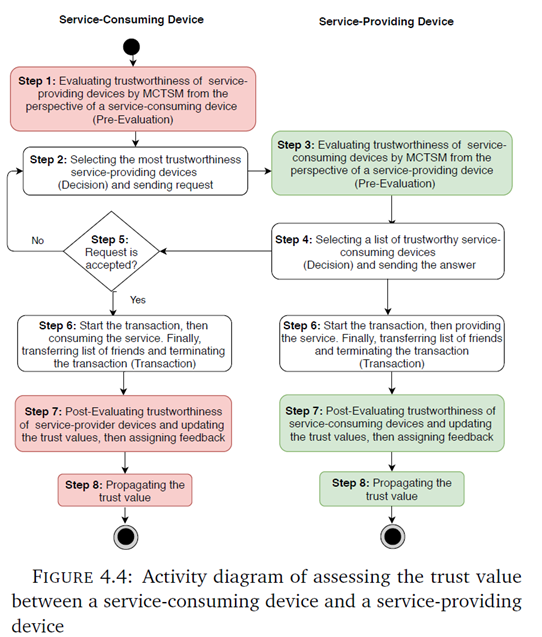
In SIoT environments, MCTSM assesses the trust for each transaction between a serviceconsuming device and a service-providing device. The details of assessing trust by MCTSM model are as follows, and Fig. 4.4 shows the inner connections between these steps by an activity diagram.
Trust is computed bidirectionally:
- SC → SP (trust in service provider)
- SP → SC (trust in service consumer)
This mutual evaluation ensures fairness and robustness in service selection.
Evaluation Metrics
Model performance is evaluated using:
- Success Rate The percentage of times the model selects the most trustworthy service.
- Trust Accuracy Agreement between computed trust values and ground-truth satisfaction levels.
- Attack Resilience
Performance under different malicious behaviors:
- BMA/BSA
- SPA
- OOA
The proposed model is compared against three baseline trust models:
- SOA (non-contextual)
- SubM (single-context, subjective)
- ObjM (single-context, objective)
Simulation Settings and Performance Comparison in SIoT Environments
Due to the absence of publicly available real-world datasets for trust evaluation in Social Internet of Things (SIoT) environments, the proposed model is evaluated using a synthetic simulation framework. The simulation consists of 600 IoT devices, including 300 service-consuming devices and 300 service-providing devices, owned by 200 users. User social relationships are derived from a synthetic Facebook social network dataset. Devices are classified as either honest or dishonest, where dishonest devices may perform trust-related attacks such as Bad-Mouthing, Ballot-Stuffing, Self-Promoting, and On–Off attacks. Ground-truth trust values are assigned based on service quality, enabling quantitative comparison between computed trust scores and actual device behavior. The proposed MCTSE model is compared against three state-of-the-art trust management models: a non-contextual model (SOA) and two single-context models (SubM and ObjM).
Summary of Settings:
The following simulation setting was designed to provide a controlled and realistic environment for evaluating the proposed trust model in SIoT. By generating a synthetic dataset with a balanced mix of honest and dishonest devices, diverse user relationships, and multiple attack types, the simulation enables rigorous testing of trust accuracy, attack resilience, and the effectiveness of the model under various real-world scenarios.
| Dataset Characteristic | Value |
|---|---|
| Total devices | 600 |
| Service-consuming devices | 300 |
| Service-providing devices | 300 |
| Total users | 200 |
| User sampling | Synthetic Facebook social network dataset |
| Devices per user | ~2 |
| Device Behavior | Description |
|---|---|
| Honest devices | High-quality services |
| Dishonest devices | Low-quality or malicious services |
| Attack types | Bad-Mouthing Attack (BMA), Ballot-Stuffing Attack (BSA), Self-Promoting Attack (SPA), On-Off Attack (OOA) |
| Ground Truth | Satisfaction Values |
|---|---|
| Honest devices | [0.80, 0.85] |
| Dishonest devices | [0.55, 0.60] |
This dataset enables controlled evaluation of trust accuracy and attack resilience.
Results
Effectiveness of Trustworthy Service Evaluation
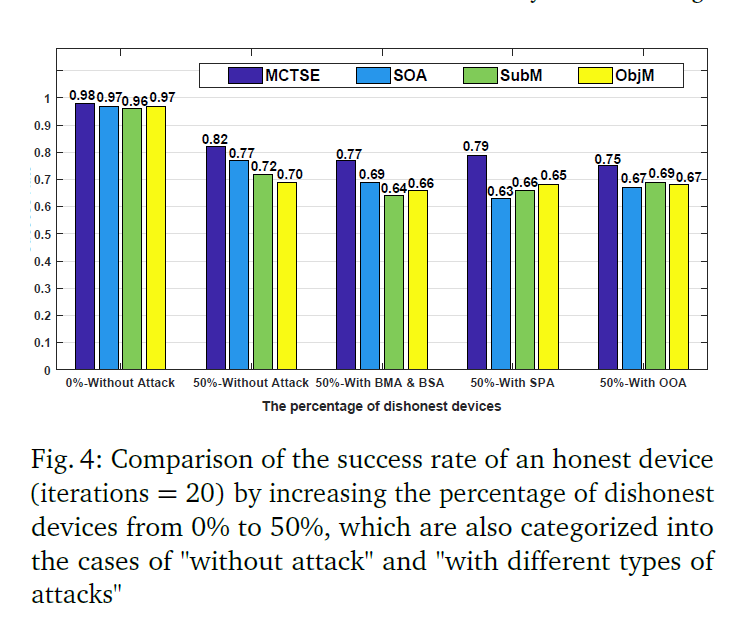
The first experiment evaluates the ability of the proposed model to select trustworthy service providers under varying proportions of dishonest devices. Scenarios include environments with 0% and 50% dishonest devices, both without attacks and under different attack strategies. Performance is measured using the success rate, defined as the probability of selecting the most trustworthy service-providing device. Experimental results show that the MCTSE model consistently achieves the highest success rate across all scenarios. Compared to baseline models, MCTSE improves service selection accuracy by up to 14%, demonstrating its effectiveness in differentiating honest and dishonest devices by leveraging multiple trust contexts.
Effectiveness in Resiliency Against Attacks
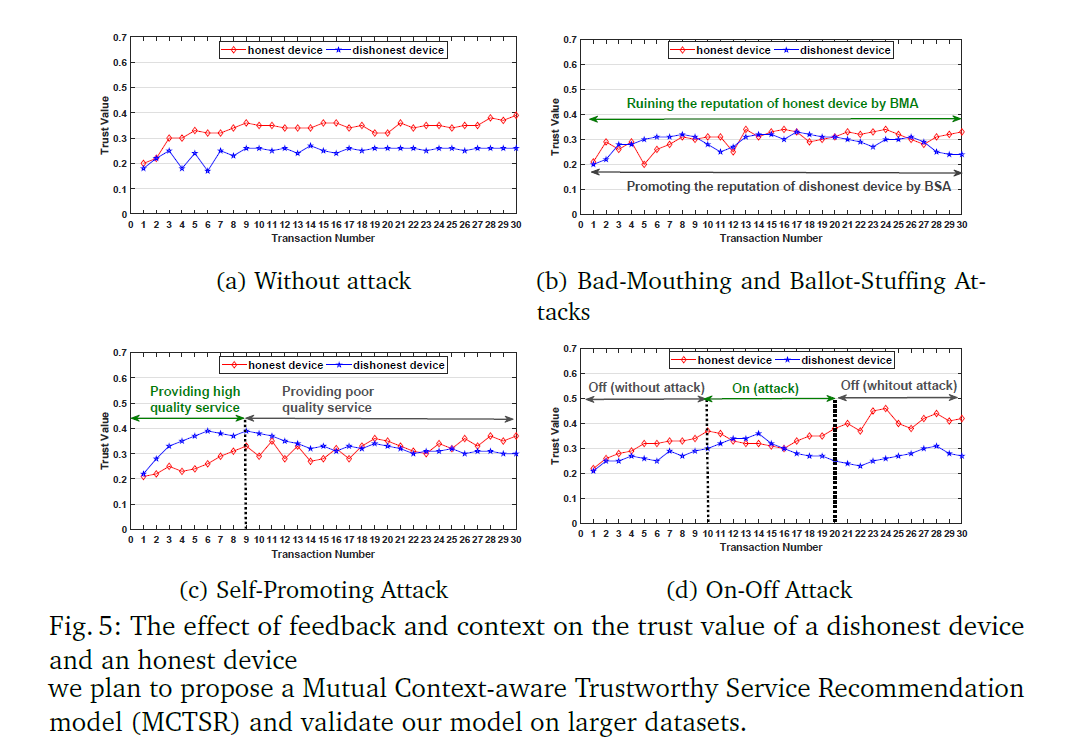
The second experiment examines the resilience of the MCTSE model against trust-related attacks over repeated transactions. Results demonstrate that dishonest devices may initially gain trust through malicious strategies such as reputation manipulation or alternating behavior. However, by incorporating contextual feedback and variance-based trust weighting, the MCTSE model rapidly detects and penalizes inconsistent or malicious behavior. Conversely, honest devices that consistently provide high-quality services experience a steady increase in trust value. These findings confirm that MCTSE effectively mitigates a wide range of attacks and maintains stable trust evaluation in dynamic SIoT environments.
Conclusion
This work proposes a Mutual Context-aware Trustworthy Service Evaluation (MCTSE) model for SIoT environments. By explicitly incorporating:
- device status,
- environment (time and location),
- task type,
- QoS similarity,
- social similarity, and
- feedback variance,
the model significantly improves the accuracy and robustness of trust evaluation.
Experimental results show that MCTSE:
- reliably differentiates honest and dishonest devices,
- resists multiple trust-related attacks,
- selects higher-quality services compared to existing approaches.
This framework provides a strong foundation for secure, trustworthy service management in future SIoT systems and opens the door to context-aware trust recommendation models.
Resources
Please find the details of the project through the following papers:
Project repository
GitHub Code: Context-aware Decision-making Framework for Trustworthy Service Evaluation in Social Internet of Things (SIoT)